Before reading please note that I typed this in word and copied into blogger. Some words are underlined for no apparent reason and I can't figure out how to change them. Also some of the images I got are from Let the Children Play, which is an awesome blog that I suggest anyone to follow. Thanks here you go.....
I believe in a curriculum that is child based and gives each child the opportunity to explore and discover in ways which are exciting and interesting to each individual child. By using such a curriculum, I believe children develop a love for school and learning. I view children as capable and competent and I hold a strong image of each child. I also feel passionate about the concept of teachers as researchers-- also adapted from the Reggio approach. As a teacher it is crucial to my practice to constantly become involved in research on issues concerning child development, government policies and education in order to become a knowledgeable advocate for children and to constantly grow in my own practice.
The Reggio Emilia approach to education is based on the following fundamentals: The child as a protagonist, the child as a collaborator, the child as a communicator, the environment as the third teacher, the teacher as partner, nurturer and guide, the teacher as a researcher, documentation as communication and the parent as partner (Cadwell, 1997, pp.5-6)
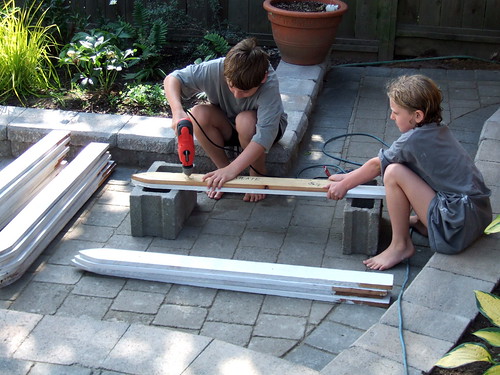
 The child as a protagonist- the Reggio approach emphasizes the importance of having a strong image of the child. This means believing that children are capable and curious. Children have a natural desire to explore the world around them and make sense of it. With the Reggio philosophy children are encouraged to become researchers and to explore their environment and world around them. Teachers also introduce materials such as working with glassor hammers and nails that othereducation approaches may notintroduce because Reggio teachers believe that children are capable of working with these materials, with the proper guidance.

 The child as a collaborator- children collaborate with each other, with teachers and with parents on projects and activities. Small group work is very important. When children are able to work in small groups they benefit both emotionally and cognitively. Emotionally they are given the chance to work with others and express their ideas to a group of peers. Cognitively children are able to witness how others solve problems, thus learning that there are several ways to solve a particular problem. It is also important for them share their opinions as well as receive compliments or constructive criticism about their own work. Children are able to construct their own approaches to learning by collaborating with their peers. (Ed. Giudici &Rinaldi, 2001, pp. 251-257). Children also collaborate with their teachers. Teachers listen and take in consideration children’s ideas and thoughts. The children and teachers often work together when choosing materials, making plans, and developing ideas for projects.

The child as a communicator- this approach promotes the concept that children have a hundred languages. Children have the right to have access to quality materials and mediums for expression. Teachers understand that there are many ways that children can tell a story or express ideas. To name a few, childrenmay use clay, paint, natural materials, blocks, dramatic play, poetry, songs and wire to communicate their thinking. All children, regardless of age, ability, or interest are able to communicate in some way. This is one reason I feel this approach is not only good for young children but also older children and children with disabilities.


 The environment as the third teacher- as a teacher who has worked in several different Reggio schools, I have witnessed how important the environment is and how much influence it has over children’s learning. This approach encourages very organized and aesthetically beautiful environments. Schools resemble that of children’s actual homes and places where they can be comfortable. There are many “intelligent materials” available that provoke thought and encourage exploration. These materials are organized thoughtfully so that children can gain the most from them. Every aspect of the space is thought out with intentionality and purpose. I have learned from this approach to always ask myself many questions, when setting up a room or redesigning one. All materials and spaces should be engaging and inviting. I believe that creating such an environment is very beneficial to children. Reggio teachers take a lot of time organizing the environment in their classrooms on a both an annual and daily basis (Strong-Wilson, Ellis, 2007, 40-47). Each year it is important to organize a classroom with materials that are developmentally appropriate for the children with which teachers are working. When organizing the environment at the start of a new school year, it is important to collaborate with colleagues and to share suggestions and ideas about a new environment. A lot of thought should be put into every aspect of the environment. With every new addition the Reggio approachhas taught me to, ask questions like: “what is the purpose of this?” ‘What might the children learn from this?” and “what are my initial hypothesis about how this space may evolve and what lessons will be learned?” I believe in making choices with meaning behind them. The physical characteristics of any school environment reveal a great deal about how children are regarded and the value assigned to the processes of teaching and learning that characterize the setting. The Reggio Emila school environments are noteworthy, not only because they are aesthetically and intellectually stimulating, but because they convey a respect for the interest, rights, needs, and capacities of those who use that space (Edwards, Gandini & Forman, 1998, p. 266). I share these goals to promote a learning environmentand for the comfort and stimulation of the children who I teach.

-Teachers as partner, nurturer and guide-. The Reggio approach to education values children as partners in their own education. Teachers respect and listen to children, always taking in their ideas and thoughts on long-term and short-term projects, as well as their input on daily routines and events. Teachers in Reggio Emilia, and those who model their style after those teachers, are dedicated to extensive professional development opportunities. These may include meeting frequently with their teaching team and other teachers in the school, attending conferences and workshops on early education and researching on their own about what the children are learning and the children themselves. Reggio teachers are continuously evolving their practice based on research and experience. These teachers are knowledgeable and prepared every day when working with children. They provide children with provocations to further their learning and are able to listen to children and take what they hear from the children to help guide explorations. Unlike many teachers who use the direct instruction model, Reggio teachers consider themselves as researchers right along with the children. They do not stand at the front of the class teaching lessons and giving problems. Instead Reggio teachers learn along the side of children. They allow children to come up with their own problems and their own way of finding the solution. These teachers do help children stay on task by asking open ended questions to facilitate thought and discussion.

Teachers as Researchers- Teachers are constantly reviewing with one another informationthat they have learned from their children and discussing ideas about what the children’s theories and hypothesis may be. They also meet together to discuss strategies for sustaining a project or for working with children in a specific learning group oron a long-term project. Teachers also meet with a pedagogista, who helps teachers develop ideas for projects. It helps teachers to be able to have a conversation weekly with a very experienced teacher to talk about projects happening in their room. Children attending schools with pedagogistas benefit greatly from their teachers having this valuable planning time and the school investing so much into the work of the children.
 |
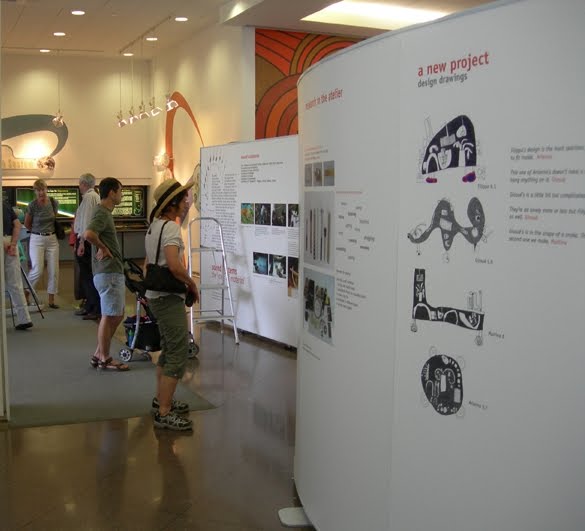
| Above: From the Hundred Languages of Children Exibit |

 Documentation as Communication: Documentation is very important to Reggio teachers and school communities embracing this approach. There are many reasons why documentation is important. One reason is that it is a way for teachers and children to reflect on their work. It serves as a reminder of the history of a school and projects. It is also a tool for teachers to use to connect theory and practice. Documentation usually is more than just telling a story about children. Often times it also connects the children’s story to child development research. By composing documentation, teachers are able to organize their thoughts and research topics that are relevant to their learning group. Documentation also helps communities and visitors gain a stronger image of children by showing the in depth and complex mental processes of which children of all ages are capable. It also serves as a communication tool between a school and parents. Many Reggio inspired schools use not only museum quality documentation for wall displays, but also use digital documentation to communicate with parents. Daily digital stories or journalsare often used to communicate with parents about their child’s day. These stories contain pictures, transcripts of children’s conversations and connect practice and theory. By connecting practice and theory daily, teacher’s help parents better understandtheir child’s development, the educational philosophy, and how the school promotes thought and interacts with their children. Documentation also shows children that teachers and parents value their work. It is very important for Reggio teachers to show children that they are important and valued.
 The parent as partner: Parents are partners in their children’s education. They are seen as a valuable and essential part of the school community. Parents are welcomed and encouraged to participate in school activities and projects. They are also encouraged to collaborate with teachers and other parents on projects to help facilitate learning (New, 2007, p.8).